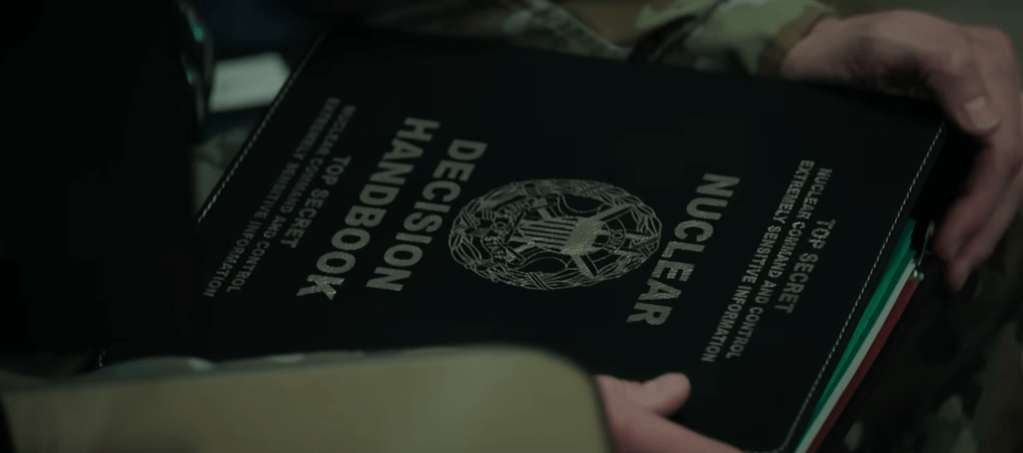

Kathryn Bigelow’s A House of Dynamite delivers a nauseating and dreadful edge-of-your-seat thriller, beginning with one of the most suspenseful first acts in years before gradually losing momentum into something just solid.
I had been excited for A House of Dynamite to finally be released, although I was initially hesitant to put it on at 2:00 AM when I was looking for something to watch. Did I really want a political thriller right now? I figured, what the hell, and decided to watch it. It’s a very straightforward premise, so I mostly knew what I was getting. For the most part, Kathryn Bigelow creates a heart-pounding hypothetical that has loomed since the Cold War—the threat of nuclear war and the terrifying ability for multiple countries to launch an attack while everyone is unprepared. It’s a situation the world has trained for, but when it’s no longer a drill, even the most competent individuals begin to crumble. On screen, we watch them fall apart when a seemingly surefire defense fails—and there’s no plan B.
The film becomes downright sickening once both Ground-Based Interceptors fail to destroy the ICBM on a trajectory toward Chicago. The only option left for everyone besides the President (Idris Elba) is to sit and watch. There’s a gut-wrenching pain in accepting this as something inevitable—that millions of lives are going to be lost in less than ten minutes as the GBIs fail to intercept. Two characters have loved ones in Chicago, but the heaviest emotional hit comes from Jared Harris’s character, the Secretary of Defense.
The film is divided into three parts, each showing a wide variety of characters processing the situation in real time. By the third go-around, however, the presentation never comes close to matching the suspense and sharp writing of the first act. It’s not bad by any means, but Bigelow can’t quite maintain that nail-biting energy once the story loops back to the beginning with a new perspective. As mentioned earlier, the Secretary of Defense, Reid Baker, is one of the film’s most pivotal figures, grounding the story in the dire reality of what’s happening. Still, it feels as though the weight of his character is used too early, leaving the final 10–20 minutes less earth-shattering than they could have been had he remained central.
I’ve read discussions suggesting A House of Dynamite is overly pro-America and blind to what the United States has done to foreign countries. Personally, I don’t see it that way by the end. The film revolves around an apocalyptic scenario already in motion—the United States becoming the target as a consequence of decades spent as a global superpower. The most powerful nation in the world is now in the crosshairs, having controlled the chessboard for so long. Fear and incompetence built over decades have led to this breaking point, where presumably North Korea decides to ignite a global nuclear war. Other global powers, like Russia, are drawn into the mix as a tense conversation unfolds between Deputy National Security Advisor Jake Baerington (Gabriel Basso) and the Russian Foreign Minister. They try to determine whether they can trust each other amid the chaos. The scene plays out with raw emotion as Baerington, knowing the ICBM will hit Chicago, gives everything he has to minimize the damage. He knows retaliation is inevitable—it’s just a matter of who strikes next.
The cast is massive, and even characters with only a few minutes of screen time are played by familiar faces. Everyone delivers strong performances, especially those in the first act set in the White House Situation Room. The dialogue feels different in some unexplainable way—maybe because, as a viewer, you’re so gripped during this phase. The first act plays like an Aaron Sorkin script, with characters bouncing off one another as the tension rises with every passing second. A House of Dynamite ultimately ends with the weakest of its three acts, but that feels unavoidable given the structure. By the time we reach the finale, we’re already conditioned to what’s being told to us, having run through a million possible scenarios in our heads as if we were living through the crisis ourselves.
Kathryn Bigelow once again delivers a strong political and war thriller, the kind she’s so great at making. I think this film is absolutely riveting—an entertaining “what if” that imagines something so dire most civilians would never see it coming until it’s too late. The fact that this film is releasing under the current presidential administration somehow makes it even more unsettling, given the level of competence (or lack thereof) displayed by the characters on screen.
Directed By: Kathryn Bigelow
Written By: Noah Oppenheim
Starring: Idris Elba, Rebecca Ferguson, Gabriel Basso, Jared Harris, Tracy Letts, Anthony Ramos, Jason Clarke, Moses Ingram, Willa Fitzgerald, Gbenga Akinnagbe, Greta Lee, Kaitlyn Dever
 ouat
ouat 
Leave a comment